
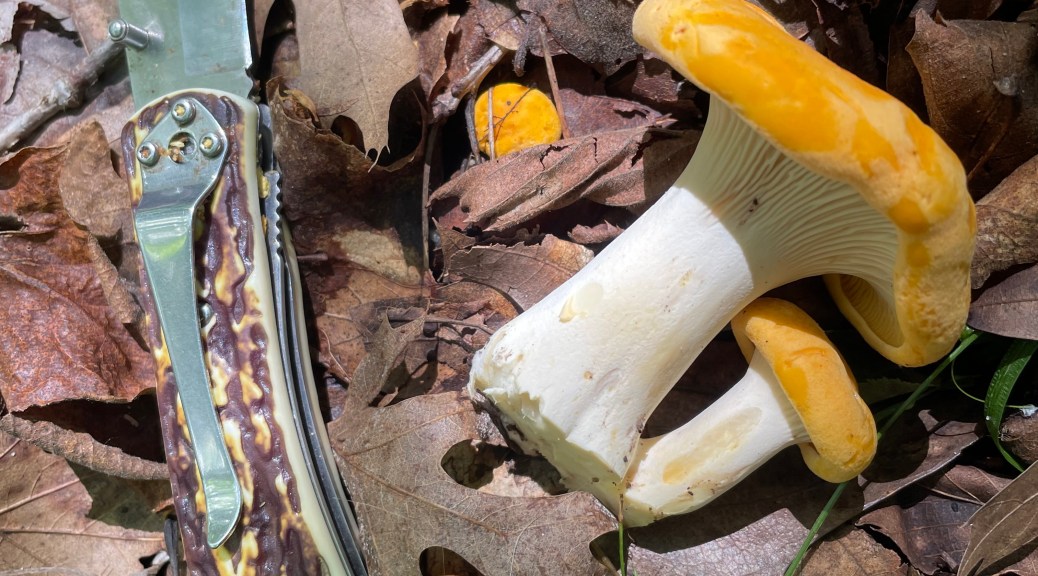
“Chanterelle”… the word alone rolls off the tongue with decadent elegance, as if reserved for royalty. This exotic name perfectly suits the flavor profile it accompanies. Dotting the floor of the mature forest, these delectable treats are like hidden golden nuggets of joy, strategically placed to share their wealth with the humble and unassuming. Their richness wafts in lacy scents of apricot, saturating the delicate yet firm white flesh. Each one is topped with what is reminiscent of soft, ochre-hued suede, pulled tight over a solid button cap and set atop a creamy stipe.
IDENTIFICATION: Chanterelles are a signature part of a forager’s summer. Found in mature forests under deciduous trees (most commonly under oaks and birch trees), and also conifers, they will be often hiding under leaf litter throughout summer, primarily starting in mid-June and extending even as late as October (in Minnesota) should growing conditions remain favorable. Growing from the ground, and NEVER from wood, they usually pop up as single bodies (occasionally found with two formed together as golden twins), which are important features to note to distinguish it from a toxic lookalike called Jack-O-Lantern mushrooms (see below for more information under the “Possible Lookalikes” section).
Golden Chanterelles are usually a buttery, yellow color, to even an egg yolk orange/yellow on top. Underneath their cap, they are an off-white, to a very pale yellow. The flesh is solid through the stem (though will get a bit pithy/sponge like holes as they age or have insects boring through), and also whiteish or very pale yellow, but erring more on shades of white rather than yellow.
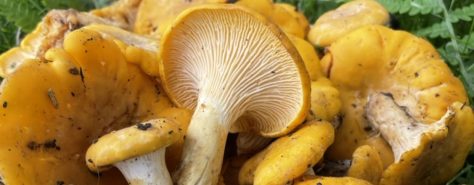
Chanterelles have what are called “false gills”. They do not have pores, and they do not actually have gills either. If they were actual gills they would be separate parallel flaps all vertically lined up in a radial fashion around the stem, each one individually attached as a separate entity from its neighboring, parallel gill. On the Chanterelle, however, upon close examination, they appear more reminiscent of work done on clay. As though the off white stem, and under the cap were made of a pale clay, it presents as though someone were to have carved with a tool, shallow, but parallel grooves in the flesh. Occasionally, if you follow the ‘carved line’, one line will fork off into two as it reaches the outer rim of the cap, proving with more certainty that it is a false gill, thus not a true gill belonging to other mushrooms, but not a Chanterelle.
The stem is almost always centrally located under the cap, and if pulled apart from the root end, it will peel apart as though it was string cheese. Perhaps one of the most defining characteristics, and surely one of the most pleasant, is its unique aroma that will become more apparent upon opening the inner flesh of the mushroom. The fragrance does carry some fungi scent, but is gently blended with sweet, apricot notes.
USES:
HARVESTING: Info coming soon!

RECIPES:
- Info coming soon!
BENEFITS: Info coming soon!
ECOLOGICAL CONSIDERATIONS: Info coming soon!
POSSIBLE LOOKALIKES:
- Jack-o-lantern: The most common mistaken identity is the Jack-o-lantern which will grow in clusters, unlike the Chanterelle that typically pops up as single fruiting bodies. Jack-o-lanterns also grow from decaying wood or roots, sometimes appearing as though growing from the soil as it is attached to buried wood (you can assure this by pulling up the mushroom to find its attachment point to see if it is attached to wood). This mushroom also is known to grow in the dark, though it is hard to see in most conditions.
- False Chanterelles
- Wooly Chanterelles
- Orange Milky Caps
WORDS OF CAUTION: Info coming soon!
DISCLAIMER: This page is intended to inspire and raise awareness of the natural word, and is not a replacement for a field guide or expert experience, nor is it intended for medical treatment or advice.
Always be 100% sure of your identification before ingesting any foraged food.Always cross-reference the information you find on the internet with an expert, a foraging group, and several reference books.
Proper identification is entirely a forager’s responsibility. . . and it is not to be taken lightly. Wild food, much like cultivated food, will produce unique results in each unique person as allergies and reactions are an ever present reality.
The experiences noted on this website are personal, but shared for your enjoyment and exploration, but are not to replace professional experience. This disclaimer is not to create fear, but rather to instill a healthy respect for the responsibility of foraging and utilizing nature in a responsible way, both for the longevity of nature and yourself, as it can only be achieved by you, as this website, owner, nor its affiliates cannot be held responsible for your actions or use of the information provided.
 The Forest Walker