
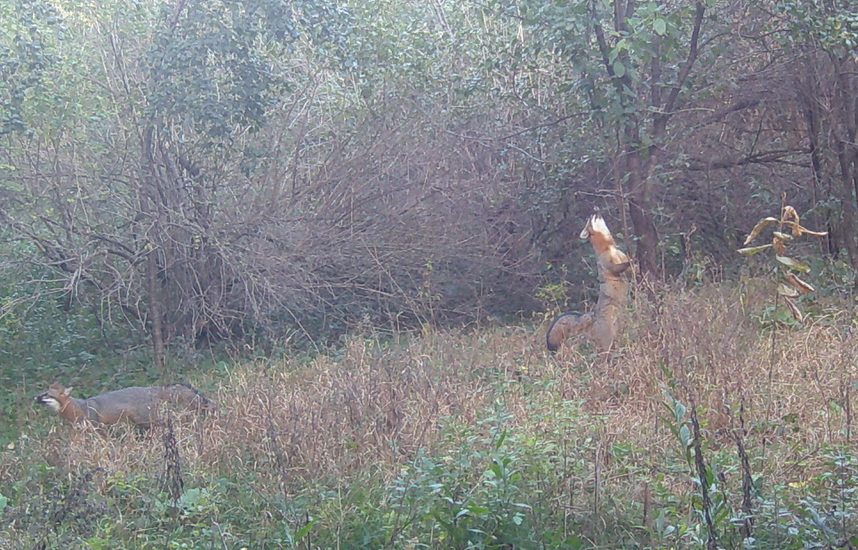
Though commonly found in heavy woodlands, the grey fox is of the most elusive creatures, seldomly seen by even biologists. Their reclusive behavior combined with their highly-functional camouflage on its own would be enough to keep them from common-sight, but they rise in their domain as some of the most secretive creatures as they exist as one of the only two canines known to regularly climb trees! (The other is an asian dwelling canine known as the raccoon dog.)
Since they are rarely seen, seeing traces of their existence is often the only way to know they ever graced a piece of woodland. They share many similarities to the red fox , but their signs will be quite distinct. Their foot pads leave a different print, appearing slightly more cat-like than the red fox, the gray fox’s scent is unique to its kind, and though their scat is similar it differs in many key features as well.
SCAT
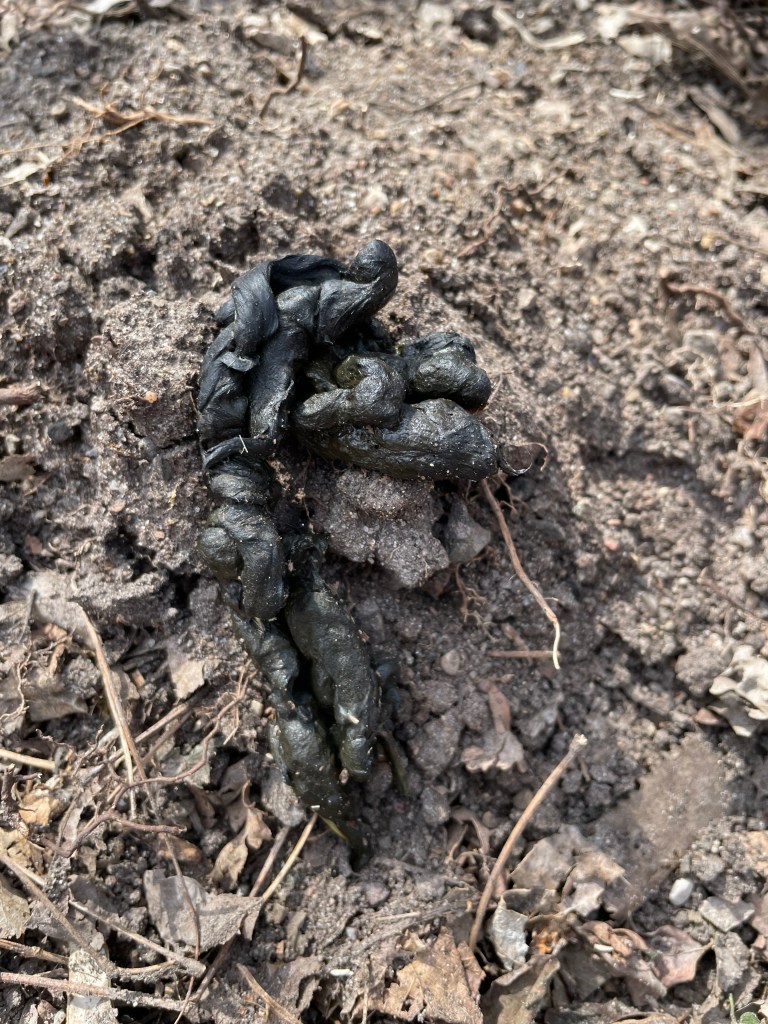
Gray fox scat is dispersed more carefully than a red fox, as the red fox will leave a nugget here, and then another there along its crepuscular travels, while the gray fox will choose with a bit more discernment. Choosing its depositories with precision, it leaves a larger amount opting for an area with strategic positioning featuring a prominent and frequented area of its territory. Often found on an elevated mound of dirt or other protruding object, it is of darker color, teetering on a black tone with a greasy appearance when its diet is high in proteins, cylindrical with some slight segmentation and twisted consistency, particularly on its tapered ends. Usually around three inches, and thin in diameter, larger than the circumference of a pencil (should it be as thin as a pencil, this is often from a mink as it shares some other common characteristics), and hovers around 1/2″ of thickness.
TRACKS
More info coming soon!
SCENT
More info coming soon!
OTHER SIGNS
More info coming soon!
 The Forest Walker