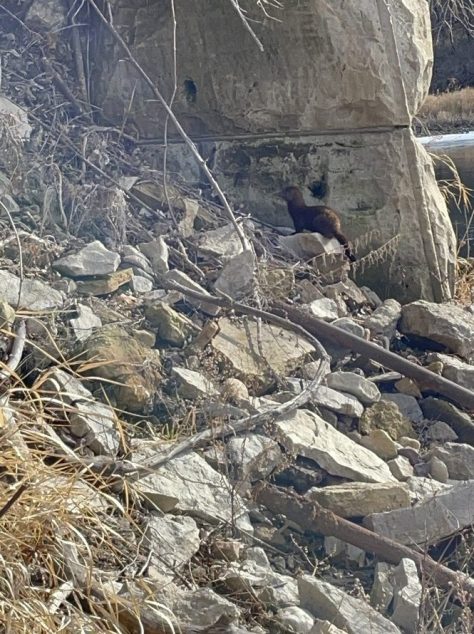
The American Mink is much less shy than its larger aquatic mammal neighbor, the River Otter, though still seldom seen. They live on river banks and spend much of their time in and around the river sharing much of their territory with other river counterparts, such as the otter, muskrats and beavers.
They are active all year round, sporting a thicker, plusher coat of fur in the winter, one that has sadly attracted much of the fur trade in trapping. They are sleek, quick, curious but cautious, and tiny but fierce. Their chocolate brown coat cloaks a long slender body with a fully-furred tail, appearing very similar to a River Otter, but smaller. Some of their behavior overlaps that of the River Otter as well, including loping, swimming, and even sliding. Their slides, however, are prioritizing energy efficiency rather than for pleasure like the River Otter.
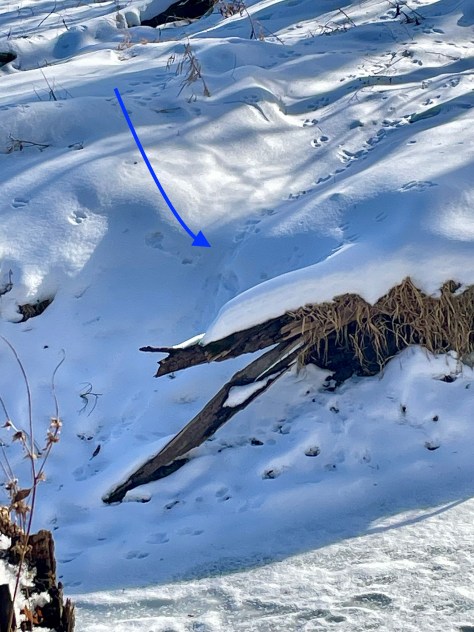
They prefer coverage from fallen trees and debris along the river’s edge to hide and hunt from to fulfill their carnivorous diet needs, eating nearly any aquatic creature including fish, crayfish, and frogs or small rodents such as mice. Mink find nesting areas in a hole burrowed directly in the soil of the river bank with an entrance around 4-6″ wide.
In a traditional bounding pattern, the mink’s tracks will land in a 2×2, tight cluster, with their hind feet usually landing in their front paw’s prints, leaving a tight cluster of paw prints up to 2″ each, with the space between each bound being 10″-24″. When traveling at higher speeds, their bound spacing can reach three feet.They have five digits, but their tracks often only register four, and usually with claws showing, and occasionally the webbed nature revealed in the imprint. The loping patterns of River Otters, tend to match the overall style of the mink, but often are longer distances between bounds, larger imprints (paws making around 4″ impressions) and often with wider slides on either flat ground or even uphill for play, vs the Mink’s use of sliding (narrower slides, measuring up to 6″ in snow) that is minimal, and only used for efficiency when going downhill.
 The Forest Walker